


Civivi Slippy Sendy Green-Red G10 Folding Knife, Satin Nitro-V by Ben Petersen (C24075B-1)
- Slippy Sendy Green-Red G10, Satin is an ultralight slip joint folding knife designed for everyday EDC use, combining modern materials with a classic non-locking design and distinct utility aesthetics.
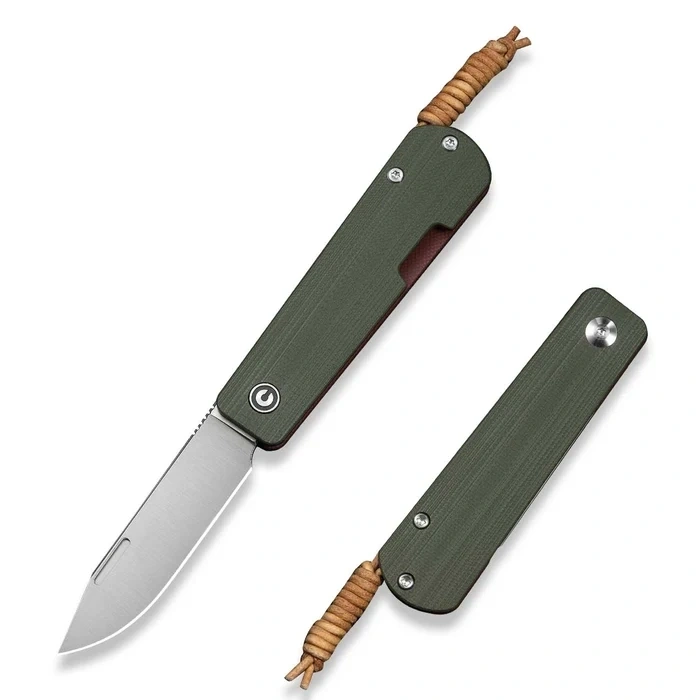
Slippy Sendy Green-Red G10, Satin constitutes an interpretation of modern EDC knife in the spirit of simplicity, functionalities and conscious limitation of mechanics. Design by Ben Petersen focuses on maximum utility at minimum form, offering a tool that remains discreet, light i intuitive to use. Type design slip joint makes the knife perfectly suited to the needs of users looking for a lock-free solution, while still providing a control i predictability of work. Spey point profile head was designed with precision cutting and safe handling of the blade during daily tasks. Applied flat grind provides a favorable balance between cutting efficiency a stability of the cutting edge, which translates into high culture of working with soft and medium-hard materials. The whole is complemented by technical finish surfaces that support the utilitarian nature of the knife. Handle made of G10 composite material gives the structure modern, character, while offering low weight, high resistance i dimensional stability. The simple, linear shape is conducive to sure grip, a presence hole and attached cable increases functionality in daily wear. Slippy Sendy is for users who value modern materials, minimalist form i consciously chosen mechanics without locking.
Ben Petersen came into contact with the knife industry in 2011, supplementing his college education with a casual job making YouTube videos. The vortex of the knife world drew him in and he spent the next 8 years working full time in the industry for a knife retailer and manufacturer. He has dealt with thousands of knives, recording more than 1,000 knife videos and producing knife marketing content for the entire industry. During his travels, Ben developed a particular preference for knives, such as blades under 3 inches and a fondness for blue handle facings in simple designs. After years of advertising other people's knives, Ben created his first EC design called "Banter." It is a thoughtful combination of all the features Ben loves in knives. When he's not working on knives, Ben spends most of his time backpacking, biking and exploring his home state of Utah with his wife and four children. And like him, they all like knives too.
Nitro-V chromium-based stainless martensitic knife steel introduced by New Jersey Steel Baron (NJSB). The manufacturer used the existing excellent knife steel AEB-L and upgraded it with nitrogen and vanadium to improve edge performance and achieve high hardness and extreme corrosion resistance, especially crucial in the marine industry and humid environments. Nitro V can be used in diving knives due to its resistance to staining and corrosion. The recommended working hardness is in the range of 58-62HRC, has very good impact strength compared to other steels. It is harder than stainless powder steels, such as M390, Elmax i S35VN. Therefore Nitro-V will be a good fit for knives that require good durability.
Head - about the profile Spey Point was designed with an emphasis on control i job security, reducing tip aggression while maintaining full cutting functionality. This shape works especially well in precision tasks, where it counts stable blade guidance and repeatability of cutting. Applied flat grind creates a thin, effective edge geometry that promotes smooth entry into the material i low resistance during cutting. This grind offers universal utility properties, linking good cutting aggression with sufficient edge durability in daily use. Satin finish reduces the visibility of minor signs of use and gives the whole thing a touch of elegance. Slip joint mechanism, based on a dorsal spring, provides controlled resistance during opening and closing, without mechanical blade locking. This solution promotes simplicity of construction, low weight and compliance with restrictive regulations concerning EDC knives in many jurisdictions.
Handle - made of G10 composite material is distinguished by its unique resistance to environmental factors and structural stability. Used in advanced technical applications, this material is perfect for EDC knives where it counts durability with minimal weight. Subtle milling of the surface improves grip control, without introducing an aggressive texture. Integrated hole and attached cable increase usability, enabling quick retrieval of the knife or securing it during operation. The whole thing forms consistent, modern form, which emphasizes slippy Sendy's utilitarian nature as a lightweight, consciously designed EDC tool.
Technical data:
Product number: C24075B-1
Product name: Slippy Sendy Green-Red G10, Satin
Overall length: 165.6 mm / 6.52"
Blade length: 71.5 mm / 2.81"
Blade thickness: 2.2 mm / 0.09"
Handle length: 94.1 mm / 3.7"
Handle thickness: 10.0 mm / 0.39"
Weight: 46.7 g / 1.65 oz
Material head: Nitro-V
Hardness head: 58-60 HRC
Grind head: Flat
Finishing head: Satin
Handle material: G10
Handle finish color: Green-Red
Backspacer Material: Stainless Steel
Backspacer color: Gray
Clip: None
Clip material: None
Pivot mechanism: Bronze washers
Lock: Slip Joint
Opening method: Manual, nail nick
Additional accessories: Pouch
Designer: Civivi
Brand name: Civivi Knife
Manufacturer: WeKnife Co., Ltd.
Country of origin: P.R.C
List of knife safety warnings based on requirements
Regulation (EU) 2023/988 on general product safety
(GPSR):
* Risk of injury: Use the knife carefully and always hold it by the handle. The blade is
very sharp and can cause serious cuts. Don't try to catch a falling
knife.
* Safe storage: the knife should be stored in a safe
place, out of reach of children and unauthorized persons. Use a blade guard if
is available.
* Use as intended: Do not use the knife for purposes for which it is not
intended, for example, for opening cans or loosening screws. This can lead to
knife damage or injury.
* Caution when cleaning: Use caution when cleaning the knife,
to avoid cuts. Do not use aggressive cleaning agents that can
damage the blade.
* Blade maintenance: Sharpen the blades regularly to keep them in good condition. Blunt
knives are more dangerous than sharp ones because they require more force, which
increases the risk of slipping.
* Transporting the knife: When transporting the knife, make sure the blade is secured,
for example, by using a vagina or sheath. This prevents accidental injuries.
* Keep your knife clean: Clean the knife regularly to remove any food debris
or other contaminants. This ensures safe and hygienic use.
* Do not modify the knife: Do not try to modify the knife or repair it yourself,
if you don't have the right skills. This can lead to damage to the knife
or injuries.
* Warning for children: knives are intended for adults only. Do not allow
children to use knives without supervision.
* Disposal: Dispose of used or damaged knives in a safe manner to
prevent accidental cuts.
This product is for adults only, who have knowledge and experience in handling sharp cutting tools. Improper use of the knife can lead to serious injury. The blade of the knife is very sharp and can quickly cut through skin and tissues; so always be very careful when slicing and do not bring your hand close to the cutting edge. To avoid slipping of the knife, it is recommended to cut on a stable and non-slip surface and avoid excessive pressure, which can cause uncontrolled movement of the blade.
Be aware that leaving a knife on the edge of a table, countertop or in easy-to-reach places, especially for children, is a danger. The knife should always be properly secured after finishing work, preferably by putting it down on a stable surface or storing it in specially designed blocks, sheaths or on magnetic strips. Never use a knife for tasks for which it is not intended, such as opening cans or using it as a lever, as this risks both damage to the tool and dangerous accidents.
Blunt blades pose an increased risk of injury because they require more force and tend to slip off the material being cut. Therefore, care should be taken to sharpen the knife regularly to maintain optimal sharpness. It is also necessary to clean and dry the tool regularly to prevent corrosion and bacterial growth. It is recommended to periodically inspect the condition of the handle and blade to detect any cracks, chipping or loosening. If damage is found, the knife should be immediately repaired or replaced with a new copy.
When using the knife, focus solely on the task at hand, avoid talking on the phone or watching TV while slicing, and make sure your work area is well-lit. You are reminded that in some countries or regions there are laws restricting the possession and carrying of knives. Before buying or using a knife, it's a good idea to make sure that using it in your location is allowed under the current law.
Adherence to the above rules will enable safe and efficient use of the knife, minimizing the risk of accidents and ensuring the long life of the tool.